The Model Selection Problem Has Changed. Here's the 2026 Framework.
In 2023, model selection was a binary decision. In 2026, you have dozens of capable models spanning free to premium tiers. The skill has shifted from 'which model is best' to 'which model is best for this specific step, at this cost, with this latency requirement.'
By George Nie, CLōD · June 2026
In 2023, model selection was a binary decision.
GPT-4 if you needed capability. Something cheaper if you didn't. The market had one frontier model, a few second-tier options, and a handful of open-source experiments most teams weren't running in production. Choosing your LLM was a one-time architecture decision you revisited occasionally, not a routing problem you solved per request.
That world no longer exists.
In 2026, a production AI team can access dozens of capable models spanning free to premium tiers, covering everything from fast lightweight completions to 480B-parameter coding specialists to 235B reasoning models with thinking capabilities. The model that would have cost $30 per million tokens in 2023 has equivalents running free today.
The skill has fundamentally shifted. It's no longer "which model is best." It's "which model is best for this specific step, at this cost, with this latency requirement."
Why the Default Is Expensive
Most engineering teams start with a default model — usually a flagship provider offering — and apply it uniformly across their pipeline. It's the path of least resistance. One API key, one pricing line item, predictable behavior.
The problem surfaces at scale.
An agentic pipeline makes dozens of model calls per completed task. A multi-step coding workflow calls the model for planning, code generation, test writing, debugging, documentation, and review. A customer-facing AI agent calls it for intent classification, retrieval, response generation, and safety checks. Not every one of those steps requires the same capability ceiling, or should pay the same per-token rate.
Routing a 235B reasoning model to classify a user intent is like taking a freight truck to pick up a single envelope. You get there, but you paid for capacity you didn't need. Multiply that decision across every step in every pipeline running at production volume, and the cost differential between "default to the best model" and "route to the right model" can reach 40-60%.
A Framework for Routing Intelligently
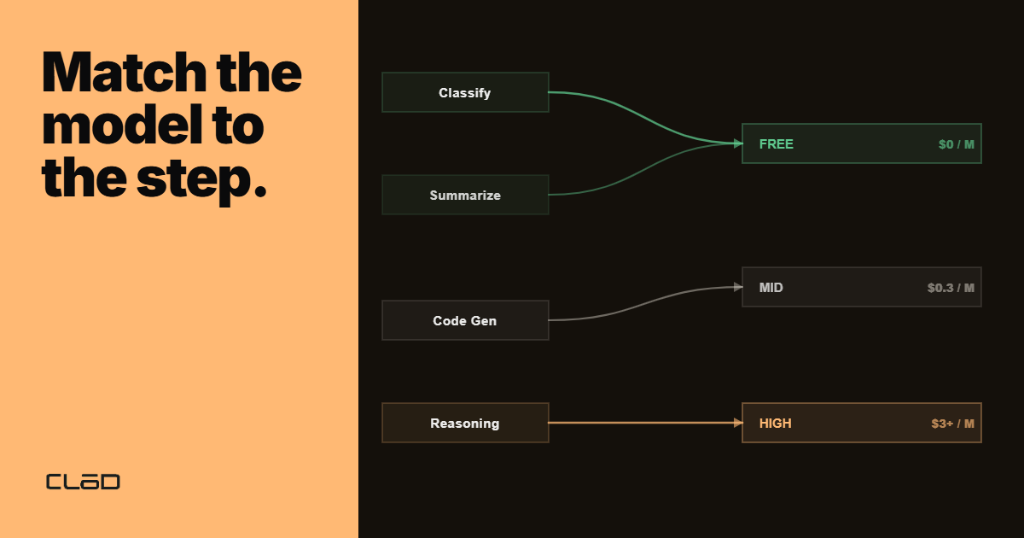
The model landscape in 2026 splits cleanly into tiers that map to task types. Here's how to think about it:
Free tier — high-volume, lower-stakes tasks
The most significant change in the 2026 model landscape is the emergence of genuinely capable free models. CLōD hosts several at $0 per million tokens:
- GPT OSS 120B and GPT OSS 20B for general-purpose completions and summarization
- Meta Llama 3.3 70B Instruct for fast, reliable text generation with a 128K context window
- Qwen 3 235B Thinking for tasks requiring structured reasoning at zero marginal cost, with 256K context
- Qwen 3.5 9B for lightweight classification and routing decisions, 262K context
- Gemma 4 31B for mid-complexity tasks with a 256K context window
- Trinity Mini for simple completions and high-frequency low-stakes calls
These aren't compromise models. A 120B-parameter open-source model handling classification, summarization, and intent routing at $0/M is a structural cost advantage for any team deploying agents at scale.
Mid-range — balanced performance and cost
For tasks requiring more capability than the free tier delivers but not the ceiling of frontier models:
- Minimax M2.5 and M2.7 ($0.30/M input, 200-228K context) for long-document tasks and structured generation
- Kimi K2.5 ($0.50/M input, 256K context) for complex multi-turn workflows
- Llama 3.3 70B Instruct Turbo ($0.88/M input) for latency-sensitive tasks needing more than the free tier
High-end — ceiling tasks that justify the cost
Premium models should be reserved for steps where quality genuinely determines outcome:
- Qwen 3 Coder 480B ($2/M input, $0.80/M output) for complex code generation — notably, output tokens are priced lower than input, making it cost-optimal for heavy codegen tasks
- DeepSeek V4 Pro ($2.10/M input, 512K context) for long-context reasoning and analysis
- DeepSeek R1 ($3/M input) for tasks requiring deep, multi-step reasoning
- Kimi K2.6 ($1.20/M input, 256K context) for demanding agentic workflows
- GLM 5.1 ($1.40/M input, 200K context) for structured outputs at scale
Beyond CLōD-hosted models, the catalog also includes 3rd-party access to Anthropic, Google, OpenAI, and xAI models through the same unified API — for teams that need frontier proprietary models alongside cost-optimized hosted options.
The Routing Logic That Changes Unit Economics
The teams running the most cost-efficient agentic pipelines in 2026 share a common approach: they map their pipeline steps to model tiers before they build, not after.
The logic is straightforward. For each step in a workflow, ask three questions: What capability does this step actually require? What's the latency tolerance? What does failure at this step cost?
Classification, intent detection, and routing decisions almost always map to free or near-free models. They're high-frequency, low-stakes, and well within the capability of today's open-source options. Intermediate generation, summarization, and structured output typically land in the mid-range. Final synthesis, complex code generation, and reasoning-heavy steps justify premium model pricing.
Routing intelligently across these tiers — rather than defaulting to a single model for all calls — is where the 40-60% cost difference compounds. Not from switching providers, not from reducing quality, but from matching model to task at the step level.
One API. 50+ Models.
CLōD's full model catalog — free, mid-range, and premium — is available through a single API key with up to 60% cheaper pricing than direct provider rates on CLōD-hosted models.
The catalog includes CLōD-hosted models from Arcee, DeepSeek, Google, Meta, MiniMax, Moonshot, OpenAI, Qwen, and ZAI, plus 3rd-party access to models from Anthropic, Google, OpenAI, and xAI.
Browse the full model listing, filter by provider, tier, context length, and pricing, and find the right models for every step in your pipeline at app.clod.io/user/models.
Get your API key free. No credit card required.
Sources