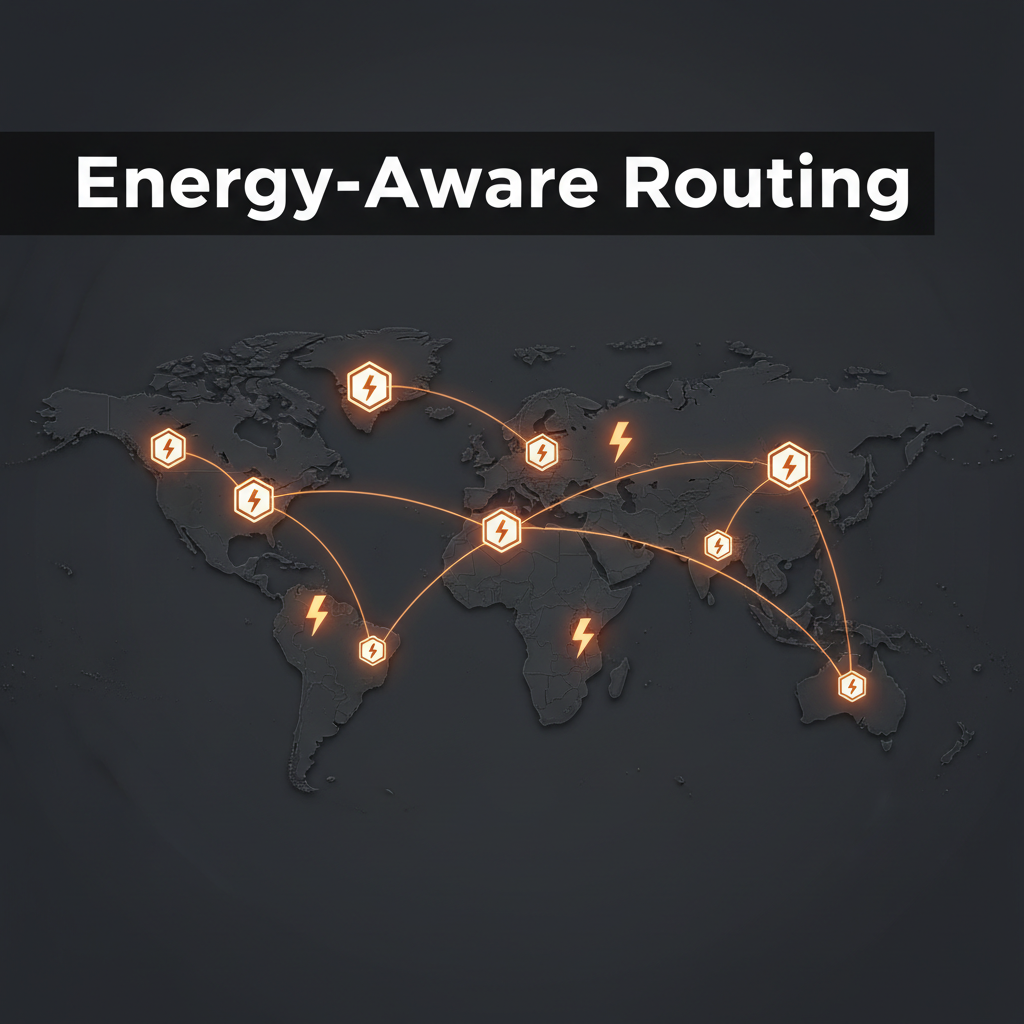
How CLōD's Patented Energy-Aware Routing Cuts Your Inference Bill by Up to 60%
A technical look at how CLōD monitors real-time electricity spot prices across AI data center regions and dynamically routes inference workloads to the lowest-cost available node — with zero integration required.
The Problem with Static Inference Routing
Most AI inference providers route requests to wherever capacity is available. That's fine for throughput. It completely ignores the single largest variable cost in running a GPU cluster: electricity.
Electricity prices fluctuate throughout the day by region — driven by grid conditions, renewable availability, demand response programs, and wholesale spot market dynamics. A GPU cluster running on surplus hydro power in Quebec at 2am operates at a fundamentally different cost basis than the same hardware drawing peak-demand grid power in Northern Virginia at 3pm. The hardware is identical. The energy cost is not.
Traditional inference routing was never designed to account for this. CLōD was.
How CLōD's Compute Flexibility Platform Works
CLōD is built on LōD Technologies' patented energy-aware compute orchestration technology — the world's first production implementation of compute flexibility specifically for AI inference workloads.
The core mechanism is straightforward: CLōD continuously monitors real-time electricity market prices across every region where AI data centers operate in our network. This includes wholesale spot prices, grid conditions, and active demand response signals from electricity markets across North America.
When an inference request arrives, CLōD's routing layer evaluates the current cost of serving that workload at each available data center region. The region with the lowest real-time energy cost — that still meets the latency requirements of the request — receives the workload. This happens automatically, in milliseconds, with no configuration required on your end.
This is meaningfully different from cost-based routing that simply checks listed pricing. CLōD responds to actual electricity market signals, the same signals that grid operators use to balance supply and demand. As CLōD's CEO Medi Naseri describes it: "Electric grids rely on price signals to balance supply and demand. CLōD extends that same mechanism to AI compute. When the grid sends a signal, workloads can respond automatically without disrupting applications or end users."
Why This Approach Is Novel (and Patented)
Data center flexibility has been discussed across the energy industry for years. Most initiatives have remained limited to concept papers, pilot programs, or demand response experiments that require operators to curtail or throttle operations during grid events — which directly conflicts with service-level agreements and disrupts end users.
CLōD solves this differently. Flexibility is implemented entirely at the routing and pricing layer, not at the infrastructure layer. Data centers and cloud providers require zero integration. Their hardware never throttles. The flexibility comes from intelligently shifting which data center receives each workload based on where energy is cheapest at that moment.
This means CLōD can participate in grid flexibility programs — responding to real-time price signals across electricity markets — without any operational risk to the underlying infrastructure providers, and without any disruption to the developers using the API.
This architecture is protected by LōD's US patent on energy-aware compute orchestration.
The Performance Impact
A common concern with geographically-aware routing is latency. Our production data addresses this directly: energy-aware routing introduces a maximum additional latency of roughly 50 milliseconds compared to routing to the nearest available node.
For the vast majority of AI inference workloads — code generation, document analysis, chat, summarization, agentic pipelines — 50ms is imperceptible. The request still completes in well under a second. The cost reduction, however, is substantial.
Early production deployments show discounts of up to 60% compared to market rates. Within days of launch, CLōD had already processed billions of inference tokens across thousands of developers — demonstrating that the model works at scale, not just in theory.
What This Means for Your Inference Bill
If you're using CLōD's API, energy-aware routing is active by default. You don't configure anything. Every request is automatically evaluated against real-time energy prices and routed to the optimal available region.
At scale, the compounding effect is significant. A team spending $10,000/month on inference through conventional providers can realistically target $4,000–6,000 in savings with no code changes — just by switching their base URL.
Beyond cost, CLōD's architecture represents a broader shift in how large-scale computing infrastructure can relate to the electricity grid. Rather than being a source of grid stress, AI compute becomes a flexible, responsive load — one that can absorb surplus renewable energy and ease peak demand. That's the longer-term vision: AI infrastructure that is economically aligned with a cleaner, more stable grid.
Getting Started
CLōD is OpenAI-compatible. If your stack speaks OpenAI, it speaks CLōD. Swap the base URL, keep your existing API calls, and energy-aware routing activates immediately.
curl https://api.clod.io/v1/chat/completions \
  -H "Authorization: Bearer $CLOD_API_KEY" \
  -H "Content-Type: application/json" \
  -d '{
    "model": "meta-llama/llama-3.1-8b-instruct:free",
    "messages": [{"role": "user", "content": "Hello"}]
  }'
The routing layer handles the rest. No infrastructure changes, no new SDK, no configuration. You call the API; CLōD finds the cheapest region to serve it.