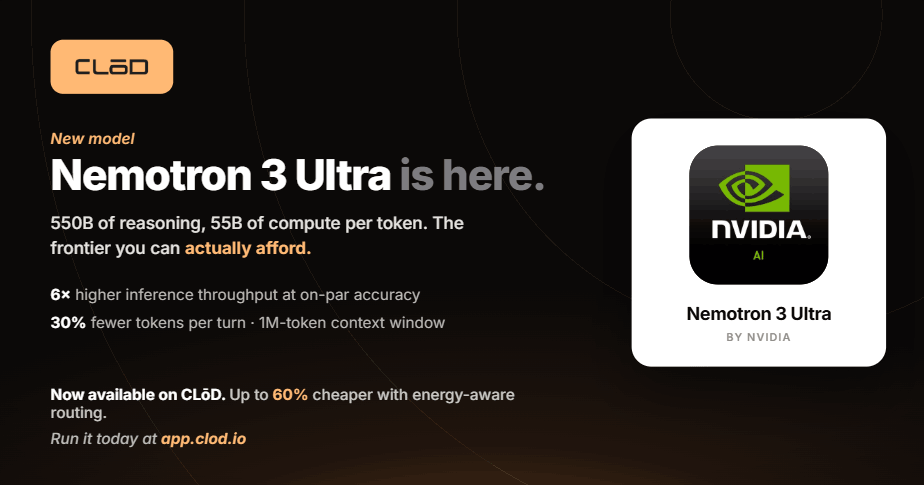
550B of Reasoning, 55B of Compute: The Inference Economics of Nemotron 3 Ultra
550B parameters, 55B activated per token. Why NVIDIA's Nemotron 3 Ultra breaks the agentic cost curve — and how energy-aware routing on CLōD stacks a second layer of savings on top.
550B parameters. If that number made you flinch at the bill, you're reading it wrong.
For anyone shipping agents to production and watching their token cost climb faster than usage, Nemotron 3 Ultra is the model that breaks the pattern. Here's why.
The cost to build an AI product is in free fall. The cost to run one is climbing fast. Every team shipping agents feels the second curve before they can explain it: the demo was cheap, then production multiplied every call by every user by every loop, and the bill stopped looking like a rounding error.
That is why the most interesting number in NVIDIA's new Nemotron 3 Ultra is not 550 billion. It is 55 billion.
Nemotron 3 Ultra has 550B total parameters and activates 55B of them per token. That gap is not a spec-sheet footnote. It is the entire argument for how you build agentic systems that stay affordable at scale. Below is why the architecture matters, layer by layer, and where the savings actually come from.
The MoE math: reasoning capacity you don't pay for on every token
A dense 550B model charges you for all 550B parameters on every single token it generates. Nemotron 3 Ultra is a sparse Mixture-of-Experts model, so it routes each token to a small subset of experts and activates roughly 55B parameters per token instead.
You keep 550B-level reasoning capacity. You pay 55B-level compute per token. For agentic workloads, where a single task can chew through thousands of tokens across dozens of reasoning steps, that ratio is the difference between a workflow you can run in production and one you can only afford to demo.
This is the first efficiency gain, and it is structural. It does not depend on a discount or a promo. It is baked into how the model computes.
Hybrid Mamba-Attention: long-running agents stop getting punished by context
Here is the failure mode most teams hit second. Standard Transformer attention scales quadratically with sequence length. Double the context, quadruple the cost. Long-running agents that accumulate history, tool outputs, and scratchpad reasoning walk straight into that wall, and the cost per turn climbs as the session grows.
Nemotron 3 Ultra interleaves Mamba-2 layers with MoE layers and keeps a few Attention layers where they earn their place. The Mamba-2 layers handle long sequences with sub-quadratic scaling, so context length stops being a cost multiplier. The retained Attention layers preserve precise recall over large contexts, which is exactly what you need when an agent has to reach back thousands of tokens to find the one detail that matters.
The model ships with a 1M-token context window. With a pure Transformer, a window that size is a cost trap. With the hybrid design, it becomes usable economics for the kind of long-horizon, multi-step agents that define serious agentic work in 2026.
LatentMoE and speculative decoding: throughput as a cost lever
Two more architectural choices turn directly into money.
Nemotron 3 Ultra uses a LatentMoE design, projecting tokens into a smaller latent dimension for expert routing and computation. Better accuracy per byte of compute moved. It also includes multi-token prediction layers for native speculative decoding, so the model proposes several tokens ahead and verifies them in fewer passes.
The result NVIDIA reports: up to roughly 6x higher inference throughput than comparable open models at on-par accuracy. Throughput is not a vanity benchmark. Higher throughput means more work per GPU-hour, which means lower cost per completed task. Speed and cost are the same variable wearing different labels.
Tighter reasoning: fewer tokens to finish the job
Architecture decides what each token costs. Reasoning quality decides how many tokens you need. NVIDIA's benchmarks show Nemotron 3 Ultra completing agentic tasks with around 30% fewer tokens per turn than comparable models.
That number does not sit still. In an agentic loop, every turn feeds the next, so a 30% reduction compounds across the whole task and again across every task you run. Fewer tokens to reach the same answer is a permanent line-item reduction, not a one-time win.
Stack the four together and the picture is clear: lower compute per token from sparse MoE, flat cost curves on long context from Mamba-2, higher throughput from LatentMoE and speculative decoding, and fewer tokens per task from tighter reasoning. Four efficiency gains in one model.
The layer NVIDIA doesn't touch: what you actually pay per token
Every gain above lives inside the model. It makes each token cheaper to produce. None of it changes the price you pay per token to whoever is running the GPUs. That is a different layer of the stack, and it is where most of the remaining cost hides.
Nemotron 3 Ultra is live on CLōD now. CLōD runs patented energy-aware routing: every inference call is directed in real time to data centers running on the cheapest available energy, so your price moves with energy markets instead of a fixed rate card. That is up to 60% below official model pricing, and it is a structural advantage rather than a promotional rate.
So the savings compound across two layers. Nemotron makes each token cheaper to produce. CLōD makes each token cheaper to buy. Model efficiency on top of infrastructure efficiency. Savings on savings.
What this means for your cost-per-task
If you are building agents or agentic workflows, the unit that matters is not cost per token in isolation. It is cost per completed task, because that is what scales with your users. Nemotron 3 Ultra attacks that number from four directions at the model layer. Energy-aware routing attacks the price underneath all four.
The math that works at 100 users has to still work at 10,000. This is what makes it work.
Nemotron 3 Ultra is available on CLōD today. One API key, up to 60% cheaper inference, and the most generous free tier in the market. Point your agents at it and watch your cost-per-task.
Start building at app.clod.io.
Sources: NVIDIA Nemotron 3 Ultra research page, NVIDIA Technical Blog, Nemotron 3 Ultra model card on Hugging Face, arXiv technical report.