Why 73% of Enterprises Blew Their AI Budget in 2026
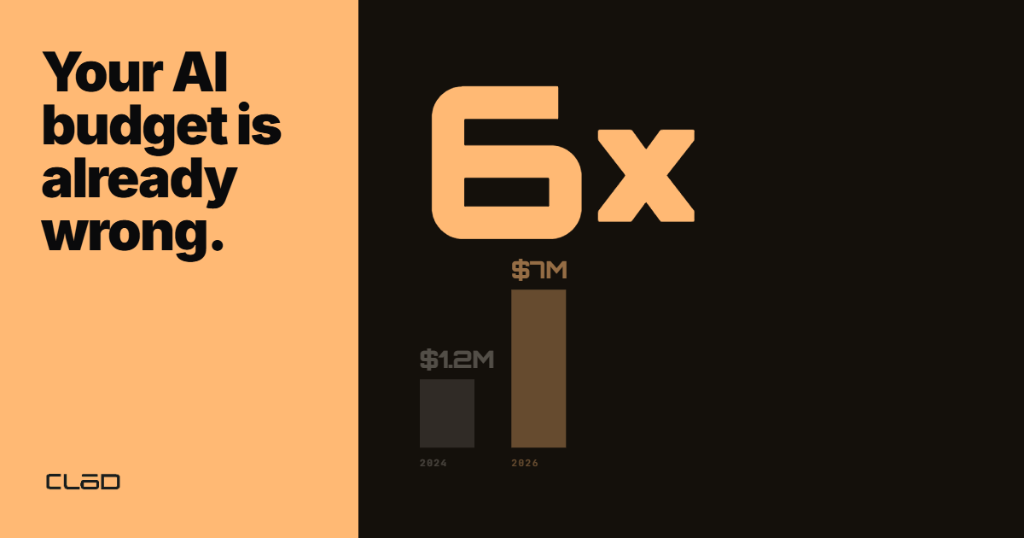
The average enterprise AI budget grew 6× in two years. The FinOps Foundation found that 73% of enterprises exceeded their AI cost projections in 2026. Here's the structural reason why — and what the teams that stayed on budget did differently.
By George Nie, CLōD · June 2026
Uber burned through its entire 2026 AI tools budget in four months.
Not 40% of it. Not most of it. All of it, by April. Their COO went on record questioning whether the spend is worth it. For a company that had actively incentivized AI adoption through internal leaderboards, it was a significant course correction.
Uber isn't a cautionary tale about AI. It's a data point about a pattern that's playing out across enterprise software teams in 2026. The companies that are most aggressively adopting AI are also the ones most likely to discover, mid-quarter, that the costs don't look anything like what they modeled.
The Budget Has Already Exploded
The average enterprise AI budget grew from $1.2 million per year in 2024 to $7 million in 2026 — a 6× increase in two years. That's not an outlier; it's the median. The FinOps Foundation's 2026 State of FinOps report found that 73% of enterprises exceeded their AI cost projections this year. Microsoft published analysis in May flagging token costs as the central problem as teams scale from assistants to agents.
Seventy-three percent. That's not a handful of companies that underestimated their infrastructure. That's a majority of enterprises, across industries, hitting a structural cost problem they hadn't anticipated.
The question worth asking isn't whether your company is at risk of the same thing. It's why this is happening so consistently — and what the teams that stayed on budget did differently.
The Chat-to-Agent Budget Trap
The root cause is almost always the same.
Teams pilot AI with a chat assistant or a single-query workflow. They measure the cost. It's manageable, often surprisingly cheap. They build a business case, get budget approved, and scale to production. Then they deploy agentic workflows: multi-step pipelines, automated tasks, concurrent agents running throughout the day.
And the bill multiplies.
Gartner's March 2026 analysis puts the mechanism in clear terms: agentic AI models require 5× to 30× more tokens per task than a standard conversational AI interaction, depending on workflow complexity. The reason is architectural. When an agent executes a multi-step task, it doesn't just make one API call. It sends its accumulated context — system prompt, conversation history, all intermediate results, all previous tool outputs — at every step. By step 20, the model has processed the original prompt 20 times. Add retries, error recovery loops, and parallel subagents, and the token count per task compounds in ways that a chat-based cost model never accounts for.
None of this shows up in the per-token rate. All of it shows up in the bill.
The teams that got surprised were doing straightforward math: tasks per day times cost per task. What they weren't modeling was the agentic multiplier — the difference between cost per single LLM call and cost per completed task in a multi-step pipeline.
What the Teams That Stayed on Budget Did Differently
There's a clear pattern among the engineering and product teams that avoided the mid-quarter surprise.
They made the inference layer decision before they scaled, not after.
That means a few concrete things. First, they had per-task cost visibility before going to production — they knew what a completed workflow cost in tokens, not just what a single API call cost. Second, they chose an inference layer that routes intelligently across model tiers, so that not every step in every pipeline hits the most expensive model. Third, they built with a free tier that let them validate workflow costs before committing to production volume.
The math that matters before you scale an agentic system is simple but easy to skip: tokens per task, times calls per day, times concurrent agents running. That number, at production volume, is a board-level conversation for many companies. Running it before deployment rather than discovering it at month-end is the difference between a controlled infrastructure decision and an emergency budget conversation.
The Inference Layer Is a Strategic Decision Now
Two years ago, inference was a line item inside an API cost. You picked a provider, set up an API key, and the cost was roughly predictable based on usage volume.
That's no longer true. As teams scale agentic workloads, the inference layer becomes the primary cost driver in the AI stack — and the provider, routing logic, and cost management tooling you choose before you scale determines whether you end up in the 73% or the 27%.
The 6× budget increase from 2024 to 2026 isn't going to reverse. Enterprise AI adoption is deepening, agent deployments are expanding, and token consumption will keep growing. The question isn't whether inference is a significant cost. The question is whether you have the infrastructure to manage it before it manages you.
CLōD is an AI inference platform built for teams scaling agentic workloads. One API. 50+ models. Up to 60% cheaper inference through patented energy-aware routing. Per-task cost visibility from day one, with a free tier that lets you validate costs before you commit.
The teams that won't be in next year's FinOps report started here.
Start free. No credit card required.
Sources
- Fortune: Uber burned through its entire 2026 AI budget in four months
- Fortune: Microsoft reports are exposing AI's real cost problem
- FinOps Foundation 2026 State of FinOps: 73% exceeded AI cost projections
- Gartner: Agentic models require 5–30× more tokens than chatbots
- Enterprise AI Budget Allocation 2026
- AI Inference Cost Crisis 2026