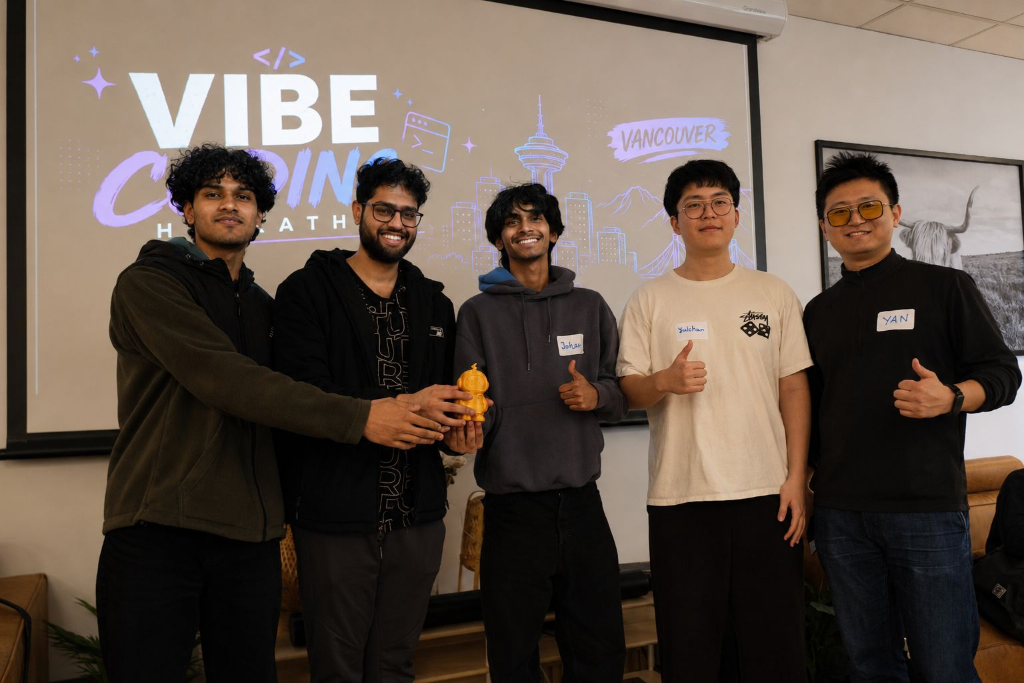
How Team Pocket Secretary built a Mac "second brain" in five hours on CLōD
Four builders walked into a five-hour hackathon, shipped a working macOS agent called Pocket Secretary, and won Best Use of CLōD — without ever hand-writing the integration. Here's how they did it.
TL;DR
Four builders walked into a five-hour "second brain" hackathon, shipped a working macOS agent called Pocket Secretary, and won Best Use of CLōD. They had never used a model gateway before. They never hand-wrote the integration. They pointed their coding agent at CLōD's docs, and it wired up the inference layer for them inside the time box.
The team
Pocket Secretary was built by Krish Vijay, Johan Naresh, Yulchan Shin, and Yash Serai — three of them already deep in AI side projects and startup work, and for Krish, only his second hackathon ever. The brief was deliberately open: one theme, "second brain," five hours on the clock.
The idea: a secretary that reads your Mac, not your patience
The inspiration came directly from Johan's startup work — a proactive second brain that takes in signals from your daily life and acts on your behalf before you have to ask. The insight that anchored the hackathon build: the context you lose fastest is the context you never wrote down. Phone calls especially.
So they built it. One button — "Sync my Mac brain" — reads what is already on the machine (iMessage, Notes, Reminders, Calendar) entirely locally, surfaces the open loops you've let slip, drafts replies in your own voice, and maps your social orbit as a graph. Nothing leaves the device.
The problem: a five-hour clock and the cost of vendor lock-in
The team's normal habit was to call model APIs directly. That works fine until you want to swap a model, mix two models in one pipeline, or stop rewriting glue code every time a provider changes its SDK. In a five-hour build, that integration tax is the difference between shipping and not shipping.
"The main thing is preventing vendor lock-in. With a gateway, the code adds a level of abstraction. The code doesn't need to know where the LLM is coming from, so it can be more general, and the gateway takes care of it. That's the most useful part of CLōD." — Krish Vijay
The solution: CLōD as the inference layer
The team routed Pocket Secretary's model calls through CLōD instead of bolting on one provider's SDK. That single decision let them treat models as interchangeable parts rather than hard dependencies. Asked to describe CLōD in one sentence, each builder landed on the same idea from a different angle:
"A single inference layer that lets you write across multiple AI models without having to manage providers." — Yash Serai
"An all-in-one hub for any LLM you would need." — Johan Naresh
The build: they didn't read the docs, their agent did
Here is the part that mattered most under a five-hour clock. The team never sat down to manually integrate. They handed CLōD's documentation to their coding agent — Codex — and let it do the reading and the wiring. This is exactly what CLōD's "For AI Agents" documentation section is built for: agent-readable integration guides so the model does the onboarding.
"We didn't hand-code anything, because it's a hackathon. The fact that the agents could go in and handle basically all the heavy lifting — reading the documentation as well as the implementation — is a pretty unique part of CLōD, and super useful. It lowers the barrier to entry, because you don't have to know how to use all the SDKs." — Krish Vijay
The result: a working macOS second brain, end to end, inside the time box.
Why it is cheaper, structurally
Most providers compete on discounts. CLōD competes on physics. CLōD routes inference workloads across data centers in the US and North America, sending each request to the region with the cheapest available energy. Because AI cost is ultimately energy cost, that routing translates into up to 60% inference savings — not a temporary subsidy, but a structural advantage backed by a US patent on energy-aware workload routing granted earlier this year.
The honest feedback
Good case studies include the friction. The team's main ask was breadth of model selection — they wanted more options, the way providers like Together.ai offer them. It's a fair point and it's on the roadmap. CLōD already serves 50+ models through one endpoint and continues to add the ones that matter most for agent workflows. The team also flagged the familiar DeepSeek tension: cheaper to go direct, but then you inherit the data-privacy questions. A gateway is how you get the price without owning that problem.
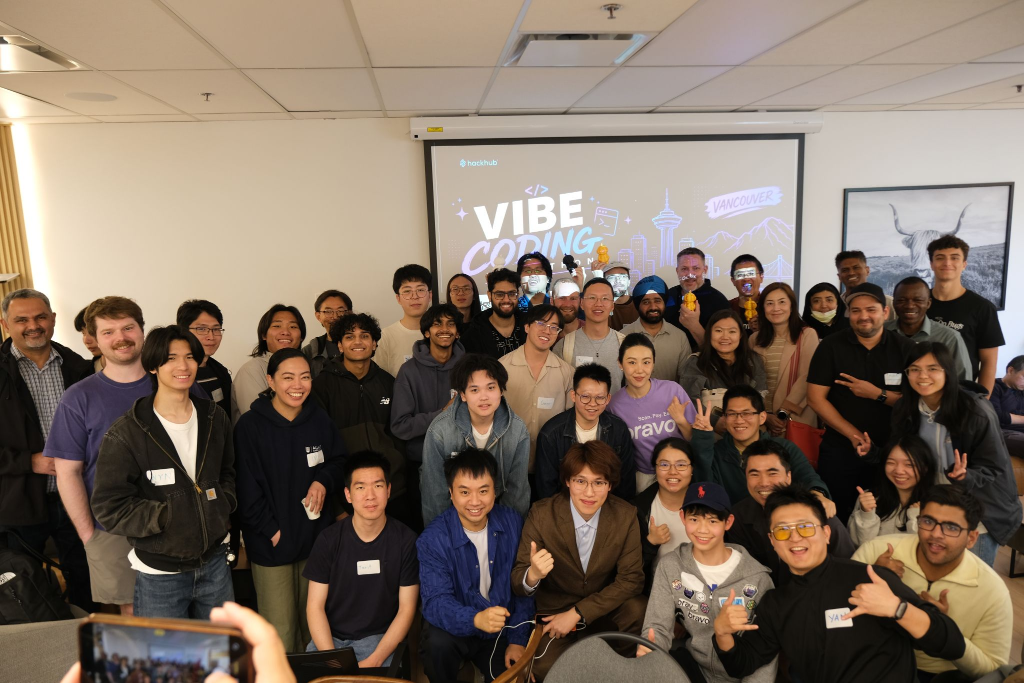 The Vibe Coding Hackathon Vancouver 2026 community — 40+ builders, one theme, five hours.
What's next
Each builder got started with CLōD credits at the event. The team is now planning what to build next — and there's real talk of turning these four into co-founders. CLōD has offered more credits and engineering support to back whatever comes next.
The takeaway for developers
If you're building with AI on a clock — whether that's a five-hour hackathon or a two-week sprint — the integration layer is where time goes to die. Pocket Secretary is the proof point: point your agent at CLōD, let it read the docs and wire the inference layer, mix models per task without vendor lock-in, and ship on energy-routed infrastructure that's structurally cheaper. Then spend your five hours on the product, not the plumbing.
Pocket Secretary won Best Use of CLōD at the Vibe Coding Hackathon, Vancouver 2026.
Code: github.com/yulchanshin/memento-pocket-secretary
Built by Krish Vijay, Johan Naresh, Yulchan Shin, and Yash Serai.