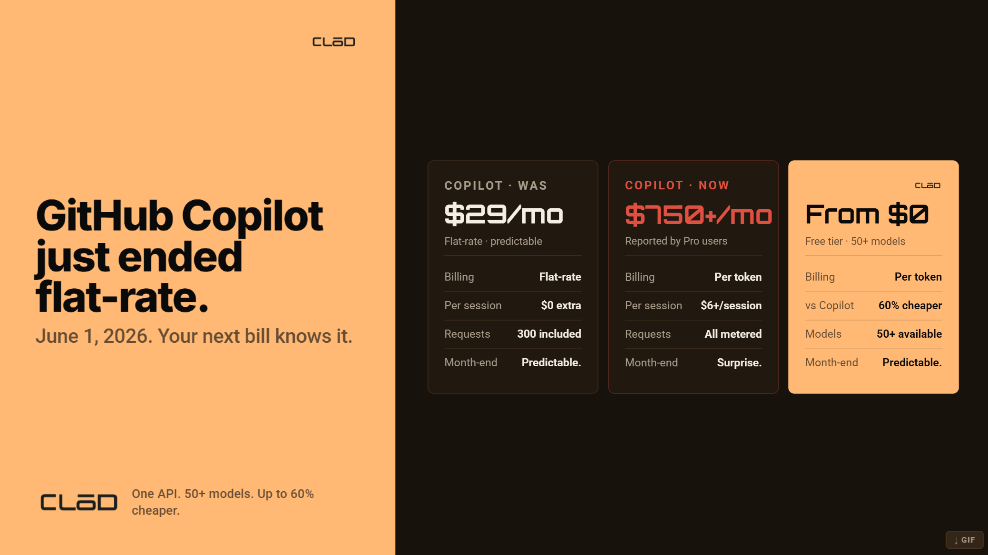
GitHub Copilot just ended flat-rate billing. Here's what agentic developers need to know.
GitHub Copilot switched to per-token billing on June 1, 2026. Agentic users are reporting 10-50x cost spikes. Here's what actually happened, why it was inevitable, and what to do before your next billing cycle.
On June 1, 2026, GitHub Copilot switched to per-token billing. By end of day, the developer community was on fire. Bills reported jumping from $29 to $750. From $50 to $3,000. A post reading "Goodbye, Copilot" spread thousands of times before noon.
But the anger is aimed at the wrong target — and the actual story is more important than the backlash.
Flat-rate was always a subsidy
GitHub said it plainly in their announcement: the same flat subscription price covered both a quick chat completion and a multi-hour autonomous coding session. Those two things don't cost the same to run. Not even close.
GitHub was absorbing the cost difference. Every time a developer ran a looped agentic pipeline, a multi-step code review agent, or an autonomous session that burned through thousands of context-loaded loops — GitHub ate the inference bill while charging the same $10 or $39 a month.
Token billing didn't create a new cost. It revealed one that was always there.
Why agentic workflows are the pressure point
Standard chat usage barely moves under token billing. Code completions aren't even touched — they remain free under all Copilot plans. The developers getting hit are the ones running agentic pipelines.
Here's the math that most teams never ran:
A single agent loop might process 4,000 tokens of context — system prompt, previous messages, file content, instructions. Run that loop 300 times across a single autonomous coding session and you're at 1.2 million tokens before you've typed a single line of your own code. Factor in retries, branching decisions, and tool calls and you're looking at 1 to 3.5 million tokens per task as a realistic average for complex agentic work.
At per-token pricing, that compounds fast. Under flat-rate, it was invisible.
Agentic code review now runs as a full GitHub Actions pipeline — every loop, every retry, every context reload is a billing event. Developers who built looped pipelines assuming flat-rate would scale with them are the ones waking up to 10-50x their previous monthly cost.
What the developers who aren't panicking did differently
They built with cost visibility from day one. Not as an afterthought when the bill arrived — as a design constraint from the first commit.
Specifically, they did three things:
They know their per-task token footprint. They've measured what an average agent run actually costs before optimising it. You can't manage what you haven't measured.
They route calls by complexity. Simple tasks — quick lookups, formatting, code completion — go to lighter, cheaper models. Complex multi-step reasoning goes to the models that actually warrant premium pricing. Not every call needs GPT-4 class inference. Most don't.
They treat the inference layer as a line item. Not a utility bill that arrives once a month as a surprise, but a variable they actively optimise the same way they'd optimise a database query or an API call.
That's not a workaround. That's the architecture that token billing was always going to reward.
What this signals for the rest of the industry
Copilot isn't an outlier. It's the first major platform to make this move publicly and loudly — but it won't be the last.
Every platform running serious agentic workloads faces the same underlying economics: the cost to serve a multi-hour autonomous session is categorically different from the cost to serve a quick query. Flat-rate pricing worked when AI tools were mostly chat interfaces. It breaks down the moment workflows become agentic, looped, and autonomous.
Cursor, Windsurf, and every other agentic coding tool is watching what happens next. The platforms that move to token billing quietly will face the same backlash Copilot faced. The ones that don't will eventually hit the same wall GitHub hit — subsidising compute costs that scale with usage while charging a flat fee that doesn't.
Token billing is the honest price of agentic inference. The question isn't whether it's coming for your stack. It's whether your stack was designed to handle it when it does.
What to do before your next billing cycle
Measure first. Pull your actual token usage for the last 30 days. Most developers have never done this — the number will surprise you.
Audit your agent loops. How many loops does your average agentic task run? What's the context window at each step? Are you carrying more context than each step actually needs?
Build a routing layer. This doesn't have to be complex. A simple classifier that routes low-complexity calls to cheaper models and reserves premium inference for tasks that need it can cut your token spend by 40-60% with minimal engineering effort.
Choose your inference layer deliberately. The platform you route through matters as much as the models you use. CLōD's energy-aware routing does this automatically — dynamically directing workloads to cost-optimised inference across 50+ models. The free tier covers enough volume to run a meaningful audit of your real production costs before you commit to anything.
The Copilot billing switch is a forcing function. Developers who treat it as a wake-up call and rethink their inference architecture now will have a structural cost advantage going into the second half of 2026. The ones who wait for the next platform to make the same move will be running this same exercise again in six months.
The token era is here. Build accordingly.
CLōD is an AI inference platform built for developers building agents, agentic workflows, and AI-powered coding tools. One API key. 50+ models. Up to 60% cheaper inference through patented energy-aware routing. Start for free →