Why Energy-Aware Routing Gets More Valuable Every Time You Scale
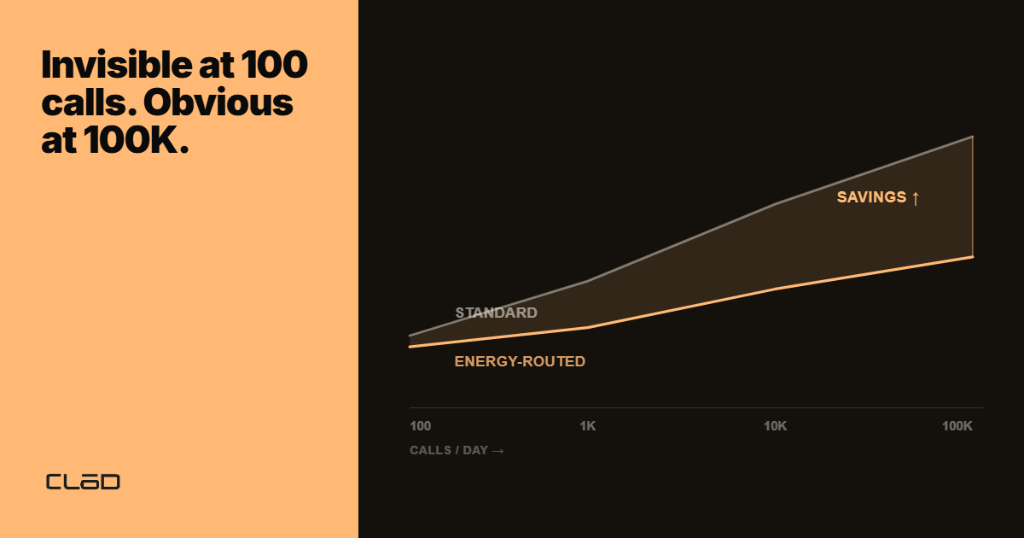
Per-call savings are invisible at 100 calls and impossible to ignore at 100,000. Here's why energy-aware routing compounds with every increment of scale.
At 100 API calls per day, the savings from energy-aware routing are a rounding error. At 10,000 calls per day, they're a meaningful budget line. At 100,000, they compound into something that looks like a structural cost advantage.
This is the nature of per-call optimization: the benefit is invisible at low volume and impossible to ignore at scale. Understanding why it works — and why it compounds specifically with inference — is the most underrated infrastructure insight for teams building AI products in 2026.
What Energy-Aware Routing Actually Is
Most inference providers make one routing decision: which model, at what price.
CLōD makes two: which model, at what price, running where — at what energy cost, at this moment.
AI data centers don't all pay the same price for electricity. A facility running on cheap hydropower in the Pacific Northwest operates at a fundamentally different energy cost per GPU-hour than one drawing from an expensive urban grid. Globally, the spread is wider. Renewable-heavy markets can price electricity at a fraction of fossil-fuel-dependent ones. Real-time energy prices fluctuate with demand, weather, and grid conditions.
CLōD's patented energy-aware routing tracks these real-time energy costs across regions and routes each inference request to the lowest-cost location that meets the latency requirement for that call. Model cost and energy cost are optimized together, as a combined variable, not separately.
This is not a feature other inference providers offer. It requires dedicated infrastructure to track energy pricing across data centers in real time and routing logic that incorporates it into every dispatch decision.
Why It Compounds With Scale
The mechanism is straightforward: every single inference call benefits from the routing decision. The savings per call may be small — fractions of a cent. But those fractions multiply by call volume, and call volume is where AI product economics diverge.
At low volume, the absolute dollar impact is negligible. At production scale — thousands of daily tasks, multiple concurrent agents, high-throughput pipelines — it becomes a consistent cost advantage on every call, every day, without any additional engineering effort on your part.
The compounding effect has two dimensions:
First, call volume. As your usage grows, the routing optimization applies to a larger base. A 15% reduction in energy-related inference cost at 1,000 calls/day is different from the same 15% at 100,000 calls/day.
Second, time. Energy prices shift with market conditions, grid composition, and infrastructure investment. The data center that was cheapest last quarter may not be the cheapest next quarter. Static infrastructure routing picks one region and stays there. CLōD's routing adapts continuously — capturing cheaper energy as it moves, not locking you into a fixed location that was optimal once.
The Independent Variable Argument
There's a strategic dimension to this that goes beyond the math.
Model prices are subject to competitive dynamics, IPO pressure, subsidy cycles, and provider strategy decisions. The per-token rate you're paying today is not necessarily the rate you'll be paying at scale in 18 months. This is not a hypothetical — it's playing out in real time as major providers prepare for public listings and transition from growth-phase pricing to margin-phase pricing.
Energy costs are a different kind of variable. They're driven by grid economics, infrastructure investment, and geographic arbitrage — not by any AI provider's business model decisions. CLōD's energy routing operates on this independent axis.
When model prices rise — as they are beginning to do — the energy routing layer continues to work in your favor regardless. The two variables don't move together. That independence is the structural advantage.
The Teams That Capture This
The teams that benefit most from energy-aware routing share a common characteristic: they made their inference layer decision early, before their call volume was high enough for the per-call savings to be visible.
By the time the savings are obvious — at 10,000+ daily calls — the cost of switching inference layers is high. Teams that recognized the compounding nature of per-call optimization and built on CLōD before they reached production scale are the ones capturing the advantage at volume.
CLōD is an AI inference platform with patented energy-aware routing. One API. 50+ models. Up to 60% cheaper inference — and a second cost variable that compounds every time you scale.
Start free. No credit card required.