AI Cost Concerns Just Became the Industry's Second-Biggest Problem
Sam Altman says AI cost went from never raised to his second-most common customer complaint. That's confirmation the infrastructure conversation has arrived.
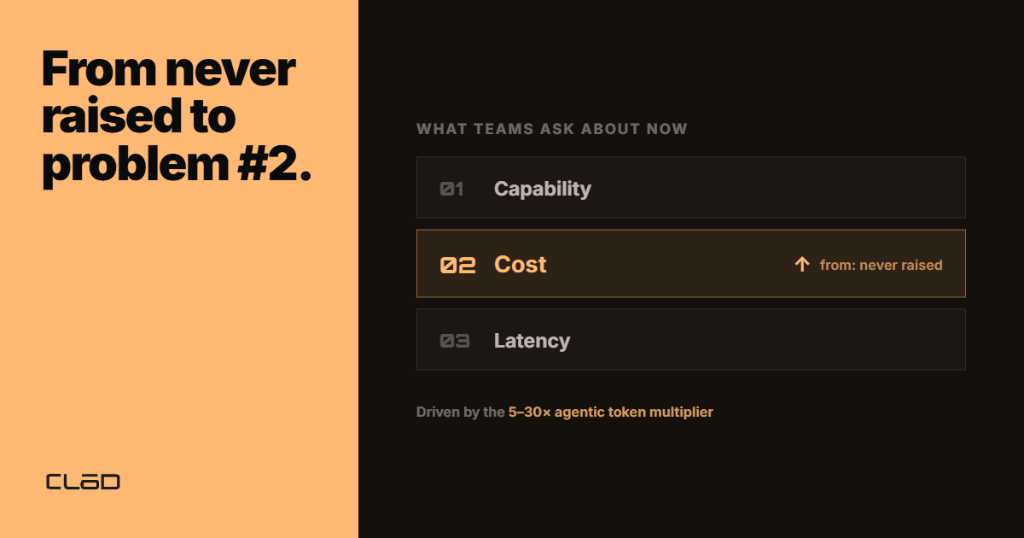
Sam Altman said it publicly in 2026: AI cost concerns went from never coming up in customer conversations to the second-most common issue he hears. Not third. Not occasional. Second.
That's not a warning sign. That's confirmation that something fundamental has shifted in how teams experience AI infrastructure — and it happened faster than almost anyone predicted.
The Timeline Matters
In 2023 and most of 2024, the AI conversation was almost entirely about capability. Which model could pass the bar exam. Which one could write better code. Which one would beat the benchmark. Cost was an afterthought — tokens were cheap, usage was exploratory, and the ROI conversation was mostly theoretical.
2025 changed the shape of the problem. Agentic workflows moved out of prototypes and into production. Teams that had been running AI as an assistant started running it as an operator — executing multi-step tasks, managing files, writing and reviewing code, handling customer interactions autonomously. The usage pattern shifted from "occasional tool" to "continuous process."
And the bill changed.
By early 2026, Uber's AI coding tool adoption had jumped from 32% to 84% of their 5,000-person engineering organization in under three months. Monthly API costs per engineer reached $500 to $2,000. The company burned through its entire annual AI budget by April. Their COO questioned publicly whether the spend was worth it.
Uber isn't a cautionary tale about AI adoption. It's a data point about what happens when teams scale agentic workflows without modeling the cost curve first.
Why the Cost Curve Surprised Everyone
The surprise isn't that AI is expensive. It's that the cost structure of agentic AI is fundamentally different from the cost structure of conversational AI — and most teams didn't update their mental model before they scaled.
A conversational AI interaction is roughly linear: one prompt, one response, one token event. An agentic workflow is not. An agent executing a multi-step task sends its accumulated context at every step. By step 20, the model has processed the original system prompt 20 times. Add retries, tool call outputs fed back into context, and error recovery loops, and the token count per task multiplies in ways that a chat-based cost model never accounted for.
Gartner put a number on it: agentic AI models require 5× to 30× more tokens per task than standard chatbots. That multiplier is the mechanism behind most of the budget overruns, and it's the reason cost concerns climbed to second place so quickly.
The teams that got surprised were doing straightforward math: tasks per day times cost per call. The bill came from the agentic multiplier they didn't model.
What the Cost Conversation Actually Means
When AI cost concerns reach the CEO level — when Altman is hearing it as his second-most common customer complaint — it signals that the infrastructure conversation has finally caught up to the capability conversation.
For two years, teams made model decisions (which LLM to use), framework decisions (which orchestration layer), and tooling decisions (which IDE plugins), and treated the inference layer as a commodity. Whatever came with the API key was fine.
That assumption doesn't survive contact with production agentic workloads at scale. The inference layer — how requests are routed, which model handles each step, whether retries are bounded, how energy costs factor in — is where the cost structure is actually determined.
The teams that recognized this early made their inference layer decision before they scaled. They have visibility into per-task costs. Their routing adapts automatically when model prices change. They don't get a surprise at month-end.
The Shift That's Happening Now
The industry is at an inflection point. The capability conversation is largely settled — there are multiple models that can handle most production tasks well. The cost conversation is just beginning to be taken seriously at the infrastructure level.
The teams that build on an inference layer designed for this — cost-aware routing, multi-model flexibility, energy optimization — will compound that advantage with every call as they scale. The teams that wait until the cost problem is obvious are the ones rebuilding their infrastructure mid-scale.
Sam Altman's second-most common complaint is a signal, not a data point. The infrastructure conversation is here.
CLōD is an AI inference platform built for teams who take the cost conversation seriously before the bill arrives. One API. 50+ models. Up to 60% cheaper inference through patented energy-aware routing.
Start free. No credit card required.