The "Accidental" Pricing Signal Every AI Team Should Take Seriously
OpenAI called its API pricing "accidental" — a signal that the price you're building on was never meant to be permanent. Here's why provider neutrality is the structural hedge.
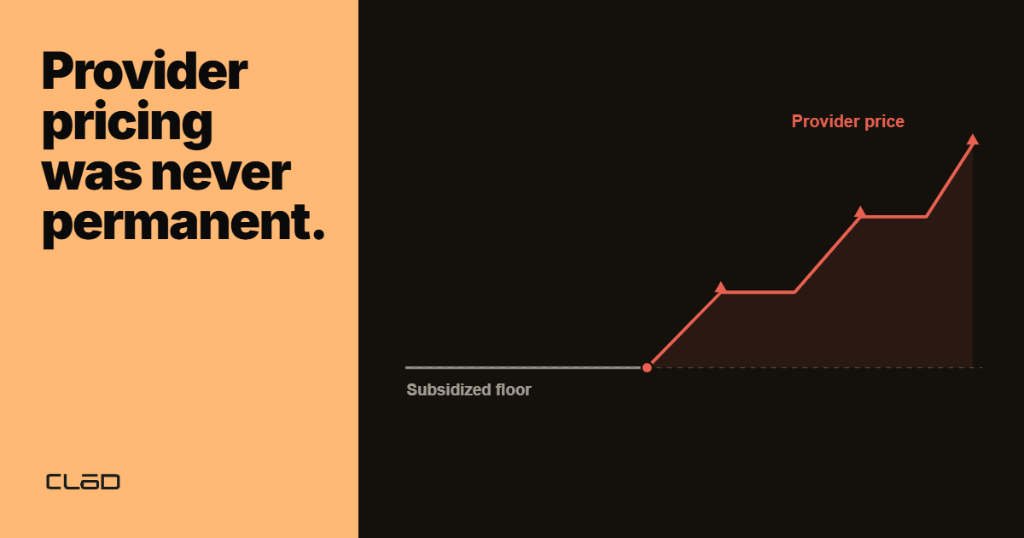
OpenAI's head of ChatGPT described the company's current API pricing as "accidental" — and signaled that significant changes are ahead. It's easy to gloss over a word like that in a product announcement. It shouldn't be.
"Accidental" pricing means one thing in practice: the price you're building on was never designed to be permanent. It's a customer acquisition strategy, not a margin strategy. And teams that treat it as a stable foundation are carrying a risk they haven't priced into their architecture.
The Pattern Is Well-Documented
This isn't the first time a platform has used subsidized pricing to build dependency before repricing.
Cloud infrastructure, developer platforms, productivity tools — the playbook is consistent. Price below cost during the land-grab phase. Let teams integrate deeply, build workflows, and accumulate switching costs. Then, once the budget line item is established and the switching cost is real, the price conversation changes.
The AI inference market is now at exactly this inflection point. OpenAI and Anthropic are both preparing for IPOs, which means transitioning from "grow at any cost" to "demonstrate a path to profitability." The people who will pay for that transition are the customers currently on subsidized rates.
The signal isn't subtle. CostLayer tracked 114 AI model API price changes in March 2026 alone. The era of stable inference pricing was already ending before the "accidental" comment surfaced.
The Lock-In Risk Is Asymmetric
If you're routing all your inference through a single provider, your exposure to a pricing change isn't just the price delta — it's the price delta times the re-architecture cost.
Teams that have deeply integrated one provider's API, fine-tuned for its specific behavior, and built their error handling around its rate limits face a real switching cost when that provider reprices. It's not just paying more per token. It's the engineering time to evaluate alternatives, migrate, re-test, and re-tune. That cost compounds with the scale of the deployment.
The teams with the lowest exposure to this risk all share one characteristic: they made their inference layer decision with provider neutrality in mind before they scaled, not after.
What Provider Neutrality Actually Looks Like
It doesn't mean never using a premium proprietary model. Claude, GPT-4o, and Gemini are in every serious production stack for good reasons — they deliver capability that open-source alternatives can't always match on specific tasks.
What it means is that no single provider controls your cost curve. Your inference layer routes dynamically based on model availability, task requirements, and pricing — not because you manually re-evaluated your stack when a price change landed in your inbox.
When OpenAI changes its pricing, your routing layer adapts. When Anthropic changes its pricing, your routing layer adapts. When a new open-source model matches the performance of a premium model at 10% of the cost — as DeepSeek V4-Pro did against frontier models in June 2026 — your routing layer captures that opportunity automatically.
The "accidental" pricing era is ending. The teams that built provider neutrality into their infrastructure before that transition are the ones who will absorb it with a lower bill, not a re-architecture project.
The Infrastructure Decision That Protects You
Routing across multiple providers through a single inference layer is the structural hedge against single-provider pricing risk. It's not an optimization you add after you've scaled — it's an architecture decision you make before you commit to production volumes.
CLōD routes across 50+ models, including both proprietary models from Anthropic, OpenAI, Google, and xAI, and CLōD-hosted models that run at up to 60% less than direct provider pricing. When any provider reprices, your routing adapts. When new models emerge at lower cost, your routing captures them.
The pricing is not accidental on our end. It's a structural advantage built on two independent variables — model price and energy cost — rather than one.
Start free. No credit card required.